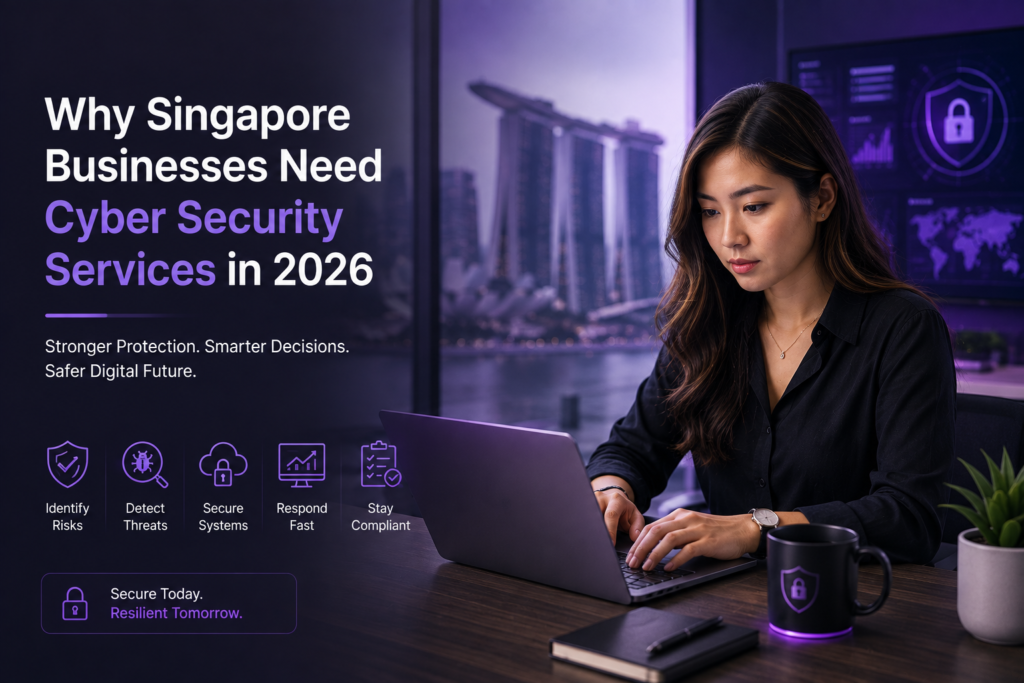
Why Singapore Businesses Need Cyber Security Services in 2026
Why Singapore Businesses Need Cyber Security Services in 2026 Singapore is a massive digital powerhouse. Just about every business here, finance, healthcare, logistics, tech, manufacturing, or retail runs on cloud systems, APIs, online payments, remote teams, and third-party providers. If you are plugged in, you are vulnerable. The more you grow online, the more cybercriminals notice. Singapore’s Cyber Security Agency (CSA) keeps a close eye on this. Their latest reports say 2025 and 2026 are bringing much tougher challenges. Ransomware is everywhere, AI is turning up the heat, and messy supply chains keep adding fuel. Cybersecurity stopped being “just IT’s problem” ages ago. Professional cyber security services in Singapore help you find weak spots, secure data, meet legal requirements, and brace for whatever attack comes next. Key Takeaways The threat landscape is getting trickier—fast. Security means covering cloud systems, code, networks, laptops, logins, and even your partners’ tech. You shouldn’t just trust that controls work. Test them. What you have to do legally depends on your exact industry and tech setup. Piecing together security tools is no match for a smart, risk-based approach. Who Needs Cyber Security Services in Singapore? Basically, if you run a business in Singapore, cybersecurity is for you. Risks and regulations might look different for a bank compared to an e-commerce startup, but the threat is always real. Companies that really need to pay attention: ✔ Banks and FinTech firms ✔ Hospitals and clinics ✔ SaaS and tech companies ✔ Manufacturers and Logistics brands ✔ Consulting and professional services ✔ SMEs storing customer data If you are deep in cloud services, relying on APIs, letting customers log in online, managing remote workers, or outsourcing to third parties, your attack surface is bigger than you think. Even the government’s SG Cyber Safe Programme gets it—your security posture changes depending on your size, digital setup, and business risk. Why Cybersecurity Risk Is Rising Rapidly Today’s businesses are built from moving parts. Your apps are in the cloud, some team members work from home, data lives in a dozen systems, and APIs connect you with the outside world. One weak link, and an attacker slips through. Ransomware, malware-as-a-service, unpatched devices, AI-based attacks, and tangled supply chains are making things harder. Risks to watch out for include phishing, account takeovers, API flaws, careless cloud setups, rogue insiders, and unpatched old systems. When attackers hit, everyone feels it. Critical systems go down, recovery costs rack up, and you lose revenue. Customers lose trust instantly, and compliance issues mean you have to prove you had the right controls. Singapore’s PDPA lays it out: You must have “reasonable” security for personal data. What Cyber Security Services Should Businesses Get? Buying more tools won’t cut it. You need a game plan based on risk find, test, and fix what matters. Vulnerability Assessment & Penetration Testing (VAPT) Check for weaknesses in your apps and networks. See if they can actually be exploited. Web, Mobile & API Security Testing Keep out easy hacks like sloppy logins, data leaks, and over-permissioned endpoints. Cloud Security Assessment Cloud setups need constant checkups for users, permissions, configs, and storage. Security Operations / Managed SOC Continuous monitoring means you will catch weird activity fast. Third-Party & Risk Assessment Figure out what assets matter most and review how vendor weaknesses affect you. Singapore Cybersecurity Compliance: What Businesses Should Know Not all companies fall under the exact same rules. The Cybersecurity Act governs critical systems and has expanded coverage in recent years. CSA now keeps tabs on Systems of Temporary Cybersecurity Concern and various “Special Interest” entities. Even some security service providers think penetration testers and managed SOCs must be licensed. Furthermore, in 2026, CSA rolled out extra Cyber Trust Mark requirements with deadlines stretching into 2027. Bottom line: Know exactly which rules apply to you. Don’t assume what worked last year still does. A Practical Cybersecurity Framework and Checklist Here is a simple, five-step plan that actually works: 1 List your critical assets Apps, data, cloud accounts, endpoints, and APIs. 2 Pinpoint cyber risks Find which weaknesses could really hurt you. 3 Test your controls Run VAPT, app tests, API reviews, and cloud assessments. 4 Boost detection and response Set up monitoring, backups, and business continuity. 5 Rinse and repeat Review security every time you add new systems or vendors. Run through this checklist before calling yourself cyber-ready: ? Had a recent cybersecurity risk assessment and done VAPT on critical systems? ? Tested customer-facing apps, reviewed API security, and checked your cloud config lately? ? Audited users with extra privileges and vetted key third-party vendors? ? Walked through incident response processes and ensured backups are ready to restore? ? Talk through your specific Singapore regulations? If you are missing more than a couple, it is time for an outside checkup. What Most Businesses Miss About Security One common misstep is assuming you are completely done after installing tools. Scanners can alert you and filter traffic, but they don’t replace proper risk assessments or third-party validation. Start asking hard questions: Can an attacker really break into our critical apps? Are our APIs sharing too much data? Could stolen passwords open the wrong doors? Are our partners making things riskier? How fast could we actually recover after a ransomware attack? Do we actually know which systems we can’t lose? The best security conversations don’t just ask about tech they ask how the business keeps running, no matter what. How Lumiverse Solutions Can Help Lumiverse Solutions brings the pieces together with deep-dive technical reviews, risk management, active monitoring, and compliance expertise. Depending on your business, we offer VAPT, Web and Mobile App Security Testing, API Security Testing, Cloud Security Assessments, Third-Party Risk Assessments, Red Team exercises, Security Monitoring, SOC services, and compliance consulting. We don’t just deliver reports, we show you which risks actually matter, how they hit your business, and exactly what to fix first. Frequently Asked Questions 1. What are Cyber Security Services in Singapore? They are professional services that help businesses
Why Singapore Businesses Need Cyber Security Services in 2026 Read More »