
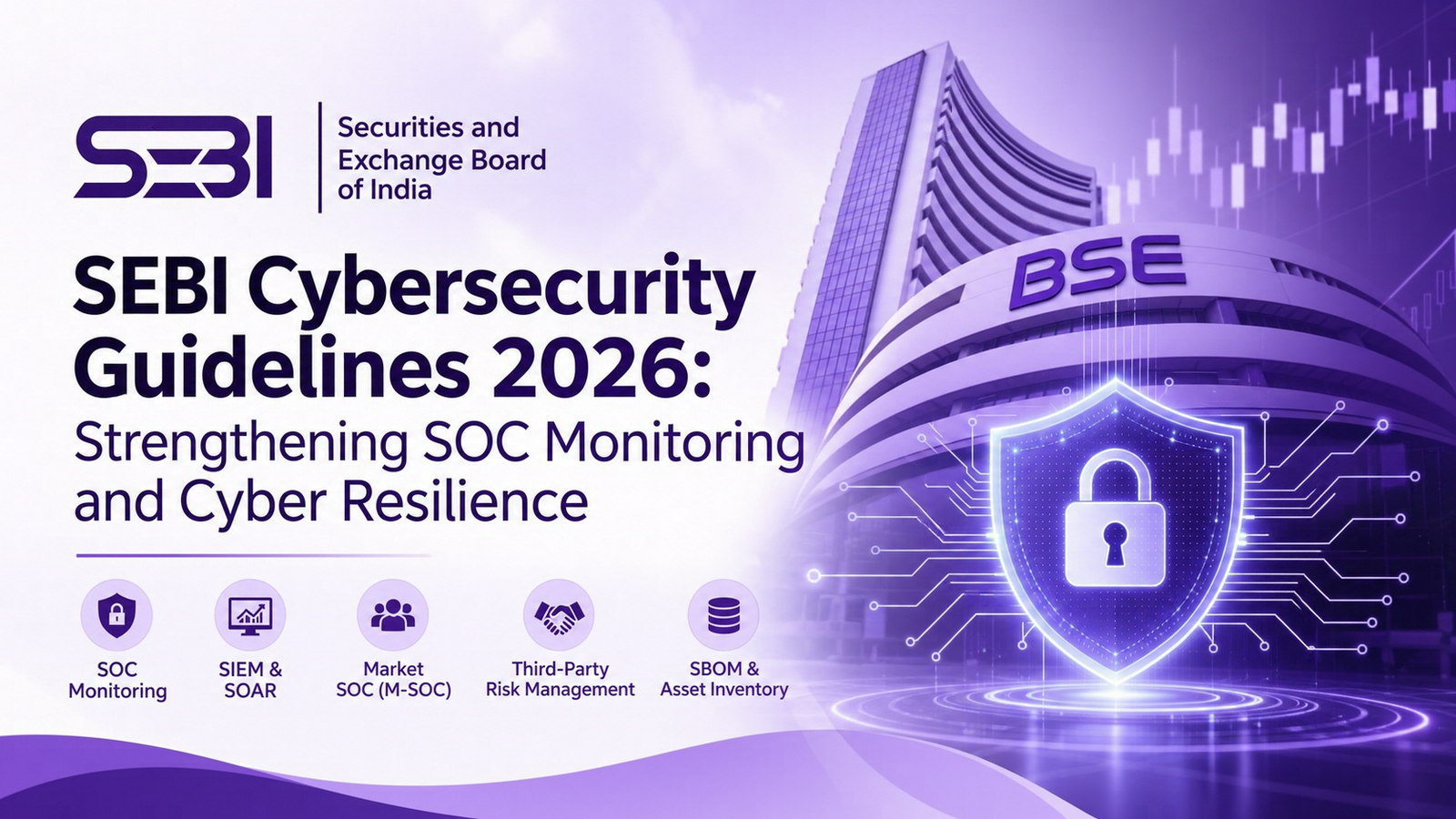
India’s capital markets and financial ecosystem have witnessed an extraordinary digital transformation over the past decade. With the rapid expansion of algorithmic trading, mobile broking platforms, cloud interconnects, and high-frequency transactions across the Bombay Stock Exchange (BSE) and National Stock Exchange (NSE), the underlying infrastructure of Indian finance has become a prime target for nation-state threat actors, organized cyber syndicates, and sophisticated ransomware operators.
In response to this shifting threat landscape, the Securities and Exchange Board of India (SEBI) has steadily transitioned its regulatory focus from traditional point-in-time security audits toward continuous, proactive operational cyber resilience. Under the evolving SEBI Cybersecurity and Cyber Resilience Framework (CSCRF) and updated 2026 cybersecurity guidance, regulated entities—including stockbrokers, trading members, clearing corporations, depositories, mutual funds, and listed enterprises—face elevated expectations around 24×7 Security Operations Center (SOC) monitoring, SIEM/SOAR integration, telemetry sharing, and third-party risk governance.
This comprehensive guide breaks down SEBI's 2026 cybersecurity directives, clarifies the distinction between statutory mandates and advisory guidance, and outlines practical technical steps for financial institutions to harden their cyber defense posture.
Key Regulatory Takeaways for 2026
- Shift from Reactive to Continuous: Annual tick-box audits are no longer sufficient; continuous, real-time threat detection and anomaly hunting are required.
- Market SOC (M-SOC) Interoperability: Regulated entities must align internal incident detection with the centralized Market SOC established by exchanges.
- Investigation of Low-Priority Alerts: Regulators emphasize that advanced persistent threats (APTs) often conceal initial footholds within benign or low-severity SIEM alerts.
- Supply Chain & SBOM Governance: Demands strict third-party risk assessments (TPRM) and comprehensive Software Bill of Materials (SBOM) for all trading and financial software.
- Standardized Cyber Incident Reporting: Adopting global frameworks like the Financial Stability Board’s FIRE format for seamless incident escalation.
Understanding SEBI's 2026 Cybersecurity Guidance
The regulatory foundation for Indian market intermediaries was codified under the landmark Cybersecurity and Cyber Resilience Framework (CSCRF), issued on 20 August 2024, followed by progressive technical clarifications (Circular 2025/119) and updated 2026 implementation guidance. Rather than viewing these updates as isolated compliance mandates, financial executives must understand the broader regulatory context.
SEBI classifies market entities across defined risk categories—ranging from Qualified Regulated Entities (QREs) like stock exchanges and depositories down to mid-sized trading members and registered investment advisors. However, the 2026 guidance emphasizes universal baseline principles across four fundamental defense pillars:
Complete inventory of critical digital assets, continuous threat modeling, shadow IT discovery, and dynamic attack surface mapping.
Multi-factor authentication (MFA), least-privilege role-based access, end-to-end data encryption, and micro-segmented network architectures.
Continuous 24×7 SOC Monitoring, behavioral SIEM analytics, SOAR automated containment, and forensic log retention.
Documented Incident Response (IR) protocols, regular cyber crisis drills, automated failover capabilities, and near-zero RTO/RPO objectives.
Why Cybersecurity Is Critical for India's Capital Markets
Unlike standard enterprise networks, capital market infrastructure operates in microsecond timeframes. A disruption of just 30 seconds during active market trading can cause catastrophic financial losses, trigger cascading margin liquidations, compromise sensitive investor records, and induce systemic panic across the national exchange ecosystem.
Recent threat telemetry indicates that financial institutions face three dominant attack vectors in 2026:
- API Manipulation & Trading Gateways: As brokers offer open algorithmic trading APIs to third-party developers, attackers target broken object level authorization (BOLA) and rate-limiting loopholes to execute unauthorized trades.
- Third-Party & Vendor Compromise: Financial institutions rarely build 100% of their software stack in-house. A vulnerability in an outsourced KYC provider, CRM platform, or order routing gateway can bypass boundary firewalls.
- Executive & Staff Phishing: Spear-phishing campaigns targeting compliance heads and traders to hijack administrative credentials and compromise trading consoles.
Organizations must adopt dedicated Cybersecurity for BFSI & Financial Services to protect these specialized digital assets.
Understanding Market SOC (M-SOC) in India
One of the most consequential strategic initiatives established under SEBI’s guidance is the Market Security Operations Center (M-SOC), orchestrated collaboratively across premier stock exchanges like BSE and NSE. The core premise of M-SOC is straightforward yet transformative: cyber threats in financial markets are shared risks.
When a malicious actor attempts credential stuffing or exploits a zero-day vulnerability against one brokerage, other market participants will inevitably face identical attack patterns within hours. The M-SOC acts as an apex threat intelligence clearinghouse, continuously synthesizing:
How M-SOC Interacts with Regulated Entities
Automated aggregation of suspicious IP pools, malicious user-agents, and command-and-control (C2) domains.
Immediate distribution of Indicators of Compromise (IoCs) to registered member CISOs when active campaigns emerge.
Establishing sector-wide immune response so a breach at one perimeter does not become systemic market contagion.
To benefit from M-SOC, however, regulated entities must operate their own capable internal or managed SOC that can consume these threat feeds, correlate them against internal telemetry, and trigger automated quarantine actions.
Role of SIEM and SOAR in Modern Cybersecurity Monitoring
Traditional log storage—where logs are passively stored in archives to fulfill periodic audit checklists—is fundamentally obsolete. SEBI’s guidance urges market intermediaries to deploy integrated Security Information and Event Management (SIEM) paired with Security Orchestration, Automation, and Response (SOAR).
The guidance highlights several technical requirements that many financial institutions have historically overlooked:
Third-Party Cybersecurity Risk Management (TPRM)
Modern stockbroking firms and financial institutions operate on extensive vendor ecosystems—from cloud hosting providers (AWS, Azure, Google Cloud) and market data feed distributors to payment gateways and SaaS messaging tools. When a vendor suffers a data breach, your organization’s data and compliance status are directly on the line.
SEBI’s regulatory guidance mandates that regulated entities implement rigorous Third-Party Risk Management (TPRM) frameworks:
- Pre-Onboarding Security Assessments: Evaluating third-party architecture, reviewing independent SOC 2 Type II and ISO 27001 certifications, and demanding periodic VAPT reports.
- Contractual Right-to-Audit Clauses: Ensuring legal agreements provide the regulated entity and regulatory inspectors the right to audit vendor systems handling market data.
- API Security Hardening: Isolating third-party APIs via strict Web Application Firewalls (WAF), mutual TLS (mTLS) authentication, and schema validation.
Asset Inventory and Software Bill of Materials (SBOM)
You cannot secure what you do not know exists. A recurring theme in SEBI’s 2026 technical guidance is the enforcement of accurate asset visibility and the adoption of a Software Bill of Materials (SBOM).
When high-severity vulnerabilities (such as Log4j or OpenSSL vulnerabilities) surface, organizations that lack an SBOM often spend weeks attempting to discover which of their trading engines or internal tools contain the affected software library. An SBOM acts as a comprehensive "ingredient list" of open-source and proprietary software components, licensing parameters, and version histories embedded in all operational binaries.
Combining SBOM tracking with continuous Cloud Security Assessments ensures that shadow infrastructure and unpatched container images are promptly remediated.
Actionable Compliance Roadmap: What Financial Institutions Must Do
To maintain audit readiness for BSE and SEBI cybersecurity inspections, CISOs, compliance officers, and IT heads should execute the following actionable roadmap:
Step 1: Perform Comprehensive VAPT Audits
Engage a CERT-In empaneled or qualified independent security auditor to conduct manual and automated VAPT Services across your internet-facing web apps, mobile broking suites, core trading servers, and cloud perimeters.
Step 2: Deploy Continuous 24×7 SOC Telemetry
Ensure all security event logs, VPN connections, firewall sessions, and privileged user actions feed into an active SIEM platform backed by 24×7 human threat analysts capable of rapid incident containment.
Step 3: Submit Corrective Action Reports (CAR) Promptly
When cybersecurity audit non-compliances are identified during annual or periodic audits, establish immediate remediation workflows and submit the auditor-verified Corrective Action Report (CAR) to the exchange within stipulated timelines.
Step 4: Enforce Email Authentication & Phishing Drills
Block spoofed executive communications by enforcing strict DMARC (p=reject) policies, and regularly conduct realistic employee simulation campaigns via CyberPhishDrill.
How Lumiverse Solutions Supports Regulated Entities
At Lumiverse Solutions, we specialize in delivering enterprise-grade cybersecurity and regulatory audit readiness tailored specifically for India’s banking, financial services, and capital market sectors. We understand that regulatory compliance is not about generic paperwork—it requires demonstrable technical resilience.
Our specialized advisory and technical security offerings include:
-
24×7 Managed SOC (SOCaaS): Continuous SIEM & SOAR monitoring, behavioral anomaly hunting, and rapid incident escalation designed to align with M-SOC feeds.
-
SEBI CSCRF & VAPT Audits: In-depth penetration testing covering trading web apps, mobile client apps, algorithmic APIs, and cloud infrastructure with comprehensive remediation guidance.
-
Strategic OEM Technology Integration: Seamlessly deploying verified security architectures across crowd-defense leaders through our Strategic Partner Ecosystem.
-
Compliance Consulting: Assisting financial firms in achieving seamless alignment with SEBI Compliance Audits, ISO 27001, and CERT-In mandates.
Prepare for Your Next Regulatory Audit
Don't wait for a regulatory notice or a security breach to discover vulnerabilities in your trading ecosystem. Partner with Lumiverse Solutions to benchmark your infrastructure against the latest SEBI and BSE cybersecurity standards.
Schedule a Security Audit Consultation →Frequently Asked Questions (FAQs)
1. What are SEBI's cybersecurity guidelines for financial institutions?
SEBI's cybersecurity guidelines encompass the Cybersecurity and Cyber Resilience Framework (CSCRF) along with periodic circulars and technical guidance. They mandate structured risk governance, identity security, continuous 24×7 SOC monitoring, independent VAPT audits, standardized incident reporting, and third-party risk management for all regulated market entities.
2. What is the SEBI Cybersecurity and Cyber Resilience Framework (CSCRF)?
Issued in August 2024 and supplemented with progressive technical clarifications, CSCRF establishes comprehensive cyber resilience standards across five core functional domains: Anticipate, Protect, Detect, Respond, and Recover. It classifies entities based on scale and operational criticality to apply tiered security controls.
3. What is Market SOC (M-SOC)?
Market SOC is an apex, collaborative security operations initiative established by major stock exchanges (such as BSE and NSE) under SEBI's direction. It synthesizes threat intelligence across capital market participants, identifies distributed threat patterns, and issues rapid security bulletins to prevent market-wide systemic contagion.
4. Why are SIEM and SOAR important for financial institutions?
SIEM (Security Information and Event Management) aggregates and correlates massive volumes of telemetry logs across servers, firewalls, and cloud networks. SOAR (Security Orchestration, Automation, and Response) executes automated playbooks to quarantine compromised systems, block malicious IPs, and triage alerts within seconds, preventing unauthorized lateral movement.
5. What is the role of VAPT in cybersecurity compliance?
Vulnerability Assessment and Penetration Testing (VAPT) simulates real-world offensive attacks against internal and external systems to identify exploitable vulnerabilities before adversaries can leverage them. SEBI requires periodic VAPT audits with independent verification and mandatory submission of Corrective Action Reports (CAR).
6. How does third-party risk management improve cybersecurity?
Third-Party Risk Management (TPRM) identifies and neutralizes vulnerabilities introduced through outsourced vendors, cloud providers, and SaaS tools. By auditing vendor security controls and enforcing strict contractual standards, financial firms ensure that third-party connections do not serve as unauthorized entryways into core trading systems.
7. What is a Software Bill of Materials (SBOM)?
A Software Bill of Materials (SBOM) is a formal, machine-readable inventory of all software components, third-party libraries, and dependencies included in an application codebase. It enables rapid identification and patching of zero-day vulnerabilities across the software supply chain.